Archive for the 'movies' Category

Larry Craig’s Exit Strategy

Friday, August 31st, 2007

I’ve been thinking through tomorrow’s announced press conference, at which it is widely reported that Sen. Larry Craig (R-ID) will announce his resignation from the Senate.

I hope that’s all he does. As I think through the various scenarios, though, I have this paranoid sense that, faced with the loss of everything he’s defined himself by, faced with the prospect of public recognition, of his own personal recognition, that he is not only a liar, but far worse, an abomination of the sort he was taught to despise from an early age, he might decide that his only way out is to kill himself.

Which is an inherently ludicrous idea on the face of it. Like the heckler who called out disdainfully at the end of his September 28 press conference, “what if you are gay? Come out of the closet.” It’s just not that big a deal, once one accepts the simple fact that his being attracted to other men is neither a disease nor a moral failing. It’s just how he is, like being left-handed.

I wouldn’t even be thinking about the possibility of a televised suicide, probably, if it weren’t for the example of Bud Dwyer. But there’s something about the zeal with which Craig has been asserting his non-gay-ness that makes me wonder how he will handle the announcement tomorrow. There’s something tense and fractured and brittle about him; he’s lived his whole life in this cage of his own construction, refusing to face the truth. How will he deal with reality? Will he be able to?

If I had to put money on it, I guess I think he’ll just continue the way he has. He’ll assert that he’s not gay, and did nothing wrong, other than the lapse of judgment that led him to plead guilty to the bathroom-incident misdemeanor. More in sorrow than in anger, for the good of the party and the people of Idaho, Nixon-like, he’ll step down. And then he’ll just continue in the closet.

But there’s that self-loathing, that mental illness, that underlies the choice to stay in the closet, and it just makes me nervous. And then there’s the Idaho factor, and his military service.

Sigh. Maybe this sense of dread I’m feeling is Stanley Kubrick’s (and Matthew Modine’s, and Vincent D’Onofrio’s) fault.


Update: So, I’m not the only one who’s anxious about this: blacktygrrrr, commenter Harold on this Rolling Stone item, and this copy-and-pasted version of the same comment in the Boise Weekly.

Later update: Whew. Resignation announced, still alive, still in the closet.

Pictures Lie, and Potter Fans Take it Seriously

Friday, May 11th, 2007

I’m a sucker for stories about doctored photos, but this one actually has a happy ending.

The folks over at “The Leaky Cauldron” (AHPNATT … All Harry Potter News, All The Time) posted an irate (but very well done) editorial recently on an Ad the IMAX website had been running for Harry potter that was very clearly a Photoshop modified version of a stock poster for the 5th Harry Potter movie. Now this shouldn’t really be a surprise — I’m sure even the poster was Photoshoped to add “mood” to the original source photos; but what was changed for the IMAX ad was to make the boobs of a 15 year female character bigger. This got the attention of some mainstream press, and Warner Brothers forced IMAX to pull the Ad, since it was not approved by them.

Which goes to show, just because photos lie, doesn’t mean you can’t call bullshit and make them stop.

Being Mma Ramotswe

Sunday, April 22nd, 2007

The new #1 Ladies Detective Agency book is here! The new #1 Ladies Detective Agency Book is here!

Ahem.

Yeah, it’s true. The new #1 Ladies Detective Agency book (The Good Husband of Zebra Drive) is here. If you haven’t read the whole series, you need to go out right now and get the first one in paperback, or at the library, and read them all the way through. They’re all the same, it’s true, but they’re also all different, and the cycling through the sameness and differences builds in power over the course of the series.

It sounds goofy to me to talk about how profoundly beautiful and wonderful these books are. I want you who haven’t experienced them to seek them out, so I want to talk about how amazing they are. But I don’t want to build up expectations that will only be realized slowly, gradually, as the stories unfold.

Hm. It’s something of a dilemma. I’ll have to think about that while looking at the big, beautiful sky above Carpinteria. And while I’m doing that, you can go to this page at Telegraph.co.uk, and see if they’ll send you the first book for free: Alexander McCall Smith exclusive. “While supplies last”, it says, and that was posted a few weeks ago, so you may need some luck there. But it also has an mp3 of Alexander McCall Smith reading a new short story based on Mma Ramotswe, which I haven’t listened to yet, so we’ve both got that to look forward to regardless.

In the meantime, I thought this was cute: Apparently a Hollywood adaptation is being done, which is worrisome, but the director is Anthony Minghella, who really is the perfect choice, and the screenplay was co-written by Richard Curtis, so that’ll probably be okay. And then there was this interesting passage in an article on the website of the (South African) Cape Film Commission, quoting from the Sunday Times of London (isn’t the Web wonderful?) Tlou mum over Mma Ramotswe role.

Botswana Minister of Health, Prof Sheila Tlou remains mum over media reports that she is the number one contender for the role of Mma Ramotswe in the multi million pula Hollywood production. Reports from the UK link the minister to the coveted role in the US$40 million film based on serialised novel No. 1 Ladies Detective by Alexander McCall Smith.

UK- based newspaper Sunday Times has quoted the author of the serialised novel, rooting for the health minister: There is one person who is really keen to play Mma Ramotswe and who has played her twice on the amateur stage in Gaborone and that’s the minister of health, Sheila Tlou.

In my view she is Mma Ramotswe and in her view she is Mma Ramotswe, the paper quoted the author.

I can not comment on what international newspapers have reported. It is just speculation right now and we will cross that bridge when the time comes, Prof Tlou said.

See, the reason that’s cute is this passage from the latest book. Mma Ramotswe and her adopted daughter, Motholeli, are up early, and Motholeli asks Mma Ramotswe if she ever thinks about whether she’d like to be someone else. This causes Mma Ramotswe to reflect on the people in her life, and the whole passage is great, including a beautiful payoff at the end, but as much as I’d like to I’m not going to quote the whole thing, so you’ll just have to get the book and read it, and again, read the whole series leading up to it so you get the full impact.

But I have to quote this part:

Motholeli, the cause of this train of thought, now interrupted it; there was to be no enumeration of the consolations of being forty-ish. “Well, Mma,” she said. “Who would you be? The Minister of Health?”

The Minister, the wife of that great man, Professor Thomas Tlou, had recently visited Motholeli’s school to present prizes and had delivered a stirring address to the pupils. Motholeli had been particularly impressed and had talked about it at home.

“She is a very fine person,” said Mma Ramotswe. “And she wears very beautiful headdresses. I would not mind being Sheila Tlou… if I had to be somebody else. But I am quite happy, really, being Mma Ramotswe, you know. There is nothing wrong with that, is there?”

Nope. Nothing at all.

RIAA, MPAA: We Want Legal Right to Lie

Saturday, April 7th, 2007

A bill aimed at cracking down on businesses that engage in “pretexting” (or, to be less precious about it, lying) in pursuit of personal information has become the target of a lobbying effort by the music and movie industries, which say they need to be able to lie in order to fight piracy: Recording, movie industries lobby for permission to deceive.

I’ve Seen the Future… And It Consists of Very Long, Unbroken Camera Shots

Monday, January 15th, 2007

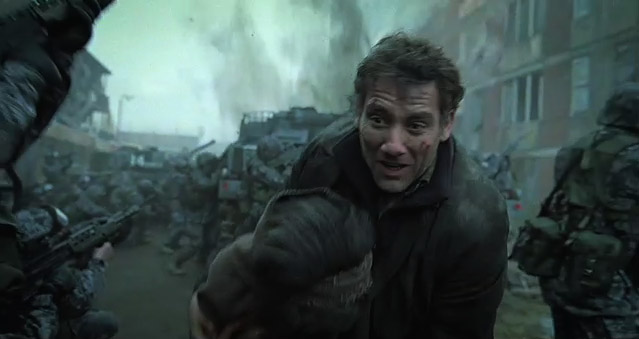
So, I went with Linda to see Children of Men yesterday. If I could go back in time and tell myself what I was about to experience, I’m not sure I’d want to, since I think my lack of foreknowledge probably added to the movie’s impact. But I’ll say this: The movie is absolutely riveting. That’s a cliché, I know, but in this case it’s apt. There was an almost physical sense of being bolted into my seat for what was (and yeah, I know it’s another cliché) a ride. And not a fun, squeals-of-joy thrill park ride, but an intense, forward-rushing journey into and through and out the other side of a dark, violent, intense place that you simply have to experience to understand.

I don’t want to get hung up on technique, because that doesn’t really do the movie justice. It’s more than the sum of its parts. But having been through the transformation I feel compelled to talk about it, and what do you talk about? You talk about the nuts and bolts, the trappings and artifice, because you hope it will connect with the person you’re talking to and get them to go on the ride themselves, and then they’ll know why you’re so excitetd.

I’ve always been a sucker for the long, unbroken shot. I get giddy watching the several-minutes-long set pieces in the recent Pride and Prejudice, for example. But in Children of Men there are so many long, unbroken shots that I lost track. Indeed, I was so caught up in the story unfolding that I don’t think I even noticed most of them. It’s only now, as I watch the clips from the movie and read interviews with Clive Owen and Director Alfonso Cuarón that I realize that many of the movie’s most-intense moments, images that are seared into my brain (again with the apt clichés), were actually delivered in unbroken, hand-held sequences that last as long as 12 minutes. Twelve minutes.

I don’t want to go all film-school geeky about this. Again, it’s not so much the technique. Children of Men isn’t merely realistic; it’s real. And it’s what Cuarón has chosen to do with that reality that has left me so stunned.

I don’t think I’m really conveying what I want to convey about the movie. I keep thinking of different things I could say about it. I could say that it has replaced Blade Runner atop my personal list of amazing, immersive visions of the near-future, and not just replaced it, but obliterated it, but that comparison (while an obvious one to make, which is why many people are making it) isn’t really fair to either movie. Children of Men isn’t competing with Blade Runner, and shouldn’t have to. But for what it’s worth, if you’re making me choose, I have to choose Children of Men.

And none of this, again, really gets at the heart of what this movie does. I’m forced to turn to someone else’s words. From Miss(ed) Manners’ What I did over Christmas vacation:

You’re terrified, but you feel for the characters, even though they are only sugar.

That’s my reaction to Children of Men. I can’t wait to see this movie again, to immerse myself in the world it creates, not because the world it creates is a particularly nice place to visit (very much the opposite), but to experience again the black magic that lets a person go somewhere like that without actually going anywhere.

See this movie.

Happy Feet Good. Casino Royale, Eh, Okay

Sunday, November 26th, 2006

Capsule review of my holiday cinema-going:

Happy Feet: Unexpectedly awesome, and proof that you don’t have to be a kid to enjoy a CGI animal movie. Casino Royale: Expectedly just a Bond movie, and confirmation that yes, I really did outgrow that genre sometime in late adolescence.

David Davis: My Borat Back Story

Tuesday, November 14th, 2006

I still haven’t seen Borat. Yes, I know it’s supposed to be terribly funny. I mostly didn’t laugh at Ali G., though, and I suspect that Borat is going to be a lot more of the same for me. I think I used up my Borat humor supply the first three or four times I saw him doing an in-character interview promoting the movie. Whatever.

In the meantime, though, I found this piece interesting: Borat. It’s by investing expert Andrew Tobias, who reposts a lengthy email from one of his readers, a guy named David Davis who apparently is one of the victims portrayed in the movie. Davis writes:

Oh, I’m famous all right. People stare at me on the DART light rail and wonder where they’ve seen me. (I’ve been in movie trailers all summer long.) Friends all over the country - and abroad! – have e-mailed and called me. Of course, the reaction is: OH MY GOSH, I KNOW THAT GUY! THAT’S DAVID DAVIS FROM THE ADOLPHUS! WHAT IN THE WORLD IS HE DOING IN THIS FILM? Friends in Hollywood have said, “When did you start acting?” I was recently introduced to Michael Sheen (he plays Tony Blair in THE QUEEN) as a fellow thespian. His face lit up as though I were truly a legitimate actor. I could’ve have crawled under the carpet and died.

On a certain level I understand the appeal of making fun of Red America. But getting people to sign releases by lying to them, then ambushing them with over-the-top obnoxiousness in order to film their reactions, seems kind of, I don’t know. What’s the word I’m looking for?

Oh, right: Lame.

Still. I should probably see the movie before passing judgement. Maybe it’s really just The Funniest Thing Evar, and I (and David Davis) need to lighten up.

Schwarz on Disney’s On-Again, Off-Again Attitude Toward Political Controversy

Saturday, September 9th, 2006

I thought this was kind of an interesting take on the Walt Disney company’s approach to airing controversial political films. From Jonathon Schwarz at A Tiny Revolution: Two Disney Movies, Two Titles Containing “9/11,” Two Strangely Different Outcomes.

So, right wing movie: Disney happily loses $30 million by running directly into a “highly charged partisan political battle.”

Left-wing movie: Disney refuses to make gigantic amounts of money because they’re so very scared they’ll “alienate many.”

Lies.com Podcast 15

Friday, April 21st, 2006

I was so jazzed about getting the last podcast successfully completed that I turned right around and recorded one the next day. So here you go: Lies.com podcast 15.

This one covers:

  • Listening to Disney obsessives, especially Jesse O. of the MousePod.
  • Again with the new Pride and Prejudice adaptation. In this installment, I realize that my resistance to crediting Keira Knightly with the stunning performance she actually delivered was simply a recapitulation of the story’s main theme: It was my own pride and prejudice that prevented me from doing so. But I’ve come to appreciate the error of my ways.
  • Arguing with Andy and John of the Hollywood Saloon that they really ought to give chick-flicks a try.
  • More Austen adapations: Sense and Sensibility, Persuasion, Emma. Must-see chick flicks all.
  • Kick-ass podcast special effects: I’m interrupted by the sight of an actual whale.

So. There it is.

Lies.com Podcast 9

Saturday, January 7th, 2006

Here you go: Lies.com Podcast 9. Featuring:

  • Bush’s illegal eavesdropping.
  • Moments of clarity.
  • High-end podcast special effects: An actual train. Heh.
  • Movie reviews (Chronicles of Narnia, King Kong, and a little Love, Actually).
  • Almost (but not quite) watching my daughter die. (Update: Please understand that I’m talking about her hospitalization several years ago, not anything that happened recently. Apologies for freaking out my non-podcast-enabled sister M’Liz.)

I actually recorded it a week or so ago, but didn’t have time to delete the “uhms” and stuff until now.

Sarah Silverman and the Aristocrats Joke That Went Too Far

Thursday, November 17th, 2005

Sam Anderson has written an interesting profile of comedienne Sarah Silverman. It’s in the latest Slate: Irony Maiden - How Sarah Silverman is raping American comedy.

I especially liked this part:

This summer, she got into trouble in a venue that was supposed to be trouble-proof: The Aristocrats, a documentary that challenged 100 comedians to offend its audience as ingeniously as possible. While most of the comics went straight for the “piss-shit-suck-fuck” paradigm, which very quickly became about as offensive as a newborn koala, Silverman turned the old-school joke against an iconic old-schooler. She implied, via an emotionally supercharged soliloquy full of loaded pauses, that she had been sexually abused by the 79-year-old show-business institution Joe Franklin. At the end, she looked straight into the camera and said, dead seriously, “Joe Franklin raped me”—an anti-punch line that completely paralyzed the theater I was at. Instead of laughing, we were all stuck trying to decide whether this was some new species of joke or just plain old slander. When Franklin threatened to sue soon after the movie was released (”I didn’t like the nature of that wisecrack”), it made the joke strangely better. Silverman was the only comic in the film who met the challenge of the joke: She pushed it too far.


George Clooney Is in a Tight Spot

Monday, October 24th, 2005

I’m a fan of George Clooney, so I found this article interesting, if worrisome: Clooney: film injury made me suicidal.

Trailers Can Lie

Sunday, October 9th, 2005

I know one of jbc’s favoite themes is “Pictures Can / Can’t Lie.” So I couldn’t resist posting these spoof trailers from the folks at PS260 (A video marketing production company)…

  • The Shining - A touching family comedy about a young boy looking for a father figure, and a struggling novelist looking for meaning in his life.
  • West Side Story - A Suspense film like no other: In the summer of 1961, 14 square blocks of Manhattan were quarantined due to an outbreak of unknown origin. This is the story of those few survivors who managed to escape from The Infected.
  • Titanic - Horror on the high seas knows no limits.
  • Cabin Fever - A tale of love and loss as a terminally ill girl takes her four best friends on one last summer trip to to say goodbye.

Heinrich: About Animals, About Us

Saturday, August 27th, 2005

I really liked this op-ed piece from Bernd Heinrich, in which he praises the documentary March of the Penguins, while addressing the broader issue of what it means to anthropomorphize animals in movies, and where one might usefully draw the line between things like Bambi and things like Winged Migration: Talk to the animals.

Paradoxically, the cartoonish anthropomorphism of “Bambi,” although it entertained the youngsters, blocked rather than promoted an understanding of animals. In “Bambi” we do not see other creatures. Instead, we are presented humans with antlers, and with our thought and speech. This is what the traditional idea of anthropomorphizing is - expecting animals to feel and behave like humans, which they never will. One look at that penguin with the egg on its toes shows the inadequacy, the outright folly, of wishing they “were more like us.”

Nature is the greatest show on earth, and reverence for life requires acknowledging the differences between ourselves and the animals as well as seeing our relatedness.

Ebert Trashes Deuce Bigalow 2

Saturday, August 13th, 2005

Not that I had any interest at all in seeing the movie, but the following Roger Ebert review is not to be missed: Deuce Bigalow: European Gigolo.

Bialik Outs Out-of-Context Movie Review Blurbs

Wednesday, July 20th, 2005

I enjoyed this item in which Carl Bialik of Gelf Magazine traces over-the-top quotes from movie reviews to their actual in-context sources: Blurb Racket 6/24/05.

The Girl in the Café (HBO)
Oregonian: “An endearing romantic comedy.”
Actual line: “This new offering from HBO Films is at its heart a bit of political propaganda wrapped into an endearing romantic comedy that starts losing its laughs when it gets to Reykjavik and decides its teachable moment has arrived.”

Charlie and the Chocolate Factory: You Want Squirrels? Then You Get Burton.

Tuesday, July 19th, 2005

Tim Burke of Easily Distracted doesn’t much like Tim Burton’s Charlie and the Chocolate Factory: Woof, Woof! Zap!

I’ve never seen a filmmaker so capable of getting so many things right and then just colossally miscalculating with horrible plot ideas or stagings that rip the guts out of everything he’s done to that point in the film.

Specifically, Burke hates Johnny Depp’s portrayal of Willie Wonka, and really hates the backstory about Wonka’s dad, the candy-hating dentist.

Well, even through the haze of the icepick behind my right eyeball that is my particular manifestation of a migraine headache, I managed to really enjoy watching this movie yesterday, and I have to disagree with Burke. This is a great film.

No, it’s not sweetly magical like the 1971 version with Gene Wilder. (Note: Burke doesn’t make that comparison. I’m responding here to some other reviews I’ve seen.) It’s darkly comic and grim. But unlike that earlier adaptation, which stylistically was standard kiddie-musical fluff, this is Tim Burton at his insane best, which means you get Vision with a capital V.

With a few prominent exceptions (mainly, the aforementioned treatment of Wonka’s character), the movie is heart-breakingly true to the book, in ways that the 1971 movie wholly missed. Which isn’t surprising, in that screenwriter John August was a childhood fan of the book who somehow had never seen the 1971 version when he was approached to do the screenplay, and who was stopped by Burton from seeing the earlier film specifically so that his approach wouldn’t be tainted by the earlier movie’s choices.

Anyway, as with Peter Jackson & Co.’s changes to The Two Towers, I don’t think it’s fair to criticize Burton and August for fleshing out Wonka’s character, because we didn’t see the movie that would have been produced had they failed to make those changes. It’s all well and good to lament that a favorite book has (gasp!) been changed on its way to the screen, but movies have a different artistic imperative than books do. If this movie had the unchanging, wryly omniscient Wonka of Roald Dahl’s book, Burke might have left the theater vaguely appreciative of the adaptation’s faithfulness, but fundamentally dissatisfied by the character’s failure to connect with him on an emotional level.

In any event, such scenarios must remain hypothetical, because this was Tim Burton’s movie, to deliver as he chose, and deliver he has. At the core of Dahl’s book are the darkly sadistic punishments that Charlie’s four awful companions bring upon themselves. When depicting those fates, the 1971 movie gave us cute. They replaced Veruca Salt’s frankly-unfilmable manhandling by nut-shelling squirrels with the much-tamer golden-egg-laying geese.

But for Tim Burton, ‘unfilmable’ isn’t a warning. It’s a challenge. And Veruca’s on-screen fate in this film is a childhood nightmare made real: at once hilarious and horrifying. As are the catastrophes that befall each of the other naughty children.

Tim Burton\'s squirrels prepare to deal with Veruca Salt

Yes, it’s a Tim Burton movie, with all the pluses and minuses that go along with that. For myself, I give the nod to the pluses. Thumbs way up.

Buy Sven’s Arnold DVDs

Tuesday, June 14th, 2005

From valued lies.com contributor Sven:

In honor of $chwarzenegger’s 80 million dollar “special election” announcement today, Jenny and I have decided to sell our entire collection of Arnold movies on Ebay:

http://cgi.ebay.com/ws/eBayISAPI.dll?ViewItem&item=6405678244

Movies and Politics

Wednesday, May 18th, 2005

With summer approaching, let’s look at some developments surrounding a few new movies. First is the dopiness surrounding “Revenge of the Sith”. It appears that a story originated out of the Cannes Snob Festival that indicated that some anti-Bush dialogue and symbolism may have been intentionally placed by George Lucas in his film. Lucas claims that his inspirations are more historically based, including Nixon, but he doesn’t dismiss talk of modern day comparisons. This has resulted in suggestions that some late-stage dialogue changes could have been possible. It’s his film and his conceptual vision, so he can obviously do as he wishes. As long as his intentional parallels don’t take away from the internal logic and flow of the movie itself, which would cheapen the movie experience and betray his long-time loyal fans, then I really don’t care. Let all the Bush-haters snicker in their popcorn with their perceived insider knowledge. However, all these preening self-important Hollywood blowhards really amaze me with their screeds about the gathering fascist storm. Lucas tries to impress everyone with his world history knowledge as he suggests possible past analogies, but he forgets his US history and discounts the strength of the American people and the ever-changing pendulum swings of power between parties. When there have been dark chapters, such as McCartheyism and Japanese internment, not to mention a Civil War, the resiliency of our democracy and its people has proven itself well over time. So while a number of alarmists (i.e. Democrats) insist we are in such a stark period now, and believe we are on a direct course to dictatorship, let me go on record and say that if Iraq’s democratic makeover should falter, and and troop levels remain over 100,000, and the economy stalls or slips back at all, then please make a note to explain to me how the cowed and mindless masses ended up electing a Democrat in 2008 (there may even be one elected regardless!).

Then there is this story about Jane Fonda’s latest repercussions from her Hanoi Jane days. This is on top of getting a faceful of tobacco juice from a Vietnam Vet during a recent book signing. In that case, the anger is understandable, but the action is quite juvenile. In regard to the article, the movie owner has every right to decide what he will or won’t show in his theatres. And given that his businesses are near Fort Knox, he likely has compelling business reasons to not offend his primary customer base. Those who really want to see that insipid (yet popular) film can go to the neighboring county or watch it on DVD in the near future (so please spare me the censorship speeches). However, it seems to me that the publicity generated by such bans just gives the movie more juice and actually helps its sales, when it would otherwise have died a quick death once Bush Wars and other big Memorial Weekend movies rush in. Plus, its not like you’re crippling Fonda herself. Its not her production company or her finances being sunk into the film. It’s not like her career will be stalled. She pretty much has gotten her money from the film already (apart from any piece of the box office, which she doesn’t likely have the “pull” to get anyway), and will get more in DVD sales.

Regardless of political overtones, let’s hope for a worthwhile collection of summer movie diversions this year!

Cruise, Spielberg, and L. Ron Hubbard: The Spiegel Interview

Monday, May 9th, 2005

Here’s a brief Q and A from the German magazine Spiegel, in which they interview Tom Cruise and Steven Spielberg about the upcoming remake of War of the Worlds. Things take a turn for the interesting when the interviewer starts grilling Cruise about his religious advocacy on-set: Actor Tom Cruise opens up about his beliefs in the Church of Scientology.

SPIEGEL: Do you see it as your job to recruit new followers for Scientology?

Cruise: I’m a helper. For instance, I myself have helped hundreds of people get off drugs. In Scientology, we have the only successful drug rehabilitation program in the world. It’s called Narconon.

SPIEGEL: That’s not correct. Yours is never mentioned among the recognized detox programs. Independent experts warn against it because it is rooted in pseudo science.

Cruise: You don’t understand what I am saying. It’s a statistically proven fact that there is only one successful drug rehabilitation program in the world. Period.

SPIEGEL: With all due respect, we doubt that. Mr. Cruise, you made studio executives, for example from Paramount, tour Scientology’s “Celebrity Center” in Hollywood. Are you trying to extend Scientology’s influence in Hollywood?

Cruise: I just want to help people. I want everyone to do well.

Spielberg: I often get asked similar questions about my Shoa Foundation. I get asked why I am trying to disseminate my deep belief in creating more tolerance through my foundation’s teaching the history of the Holocaust in public schools. I believe that you shouldn’t be allowed to attend college without having taken a course in tolerance education. That should be an important part of the social studies curriculum.

SPIEGEL: Mr. Spielberg, are you comparing the educational work of the Shoa Foundation with what Scientology does?

Spielberg: No, I’m not. Tom told you what he believes in, and after that I told you what I believe in. This is not a comparison between the Church of Scientology, the Shoa Foundation and the Holocaust. I was only showing you that some of us in Hollywood have set out to do more than just be actors or directors. Some of us have very personal missions. In Tom’s case, it’s his church, and in my case, it’s the Shoa Foundation, where I’m trying to help other people learn about the mortal dangers of pure hatred.

SPIEGEL: How do you set about doing that?

Spielberg: I think that the only way we’re going to teach young people not to kill each other is by showing them the reports by the survivors of the Holocaust — so that they can tell them in their own words man’s inhumanity to man. How they were hated. How they were displaced from their homes. How their families were wiped out and how by some miracle they themselves survived all that.

Cruise: How did the Holocaust start? People are not born to be intolerant of others. People are not born bigots and racists. It is educated into them.

Spiegel: Mr. Cruise, as you know, Scientology has been under federal surveillance in Germany. Scientology is not considered a religion there, but rather an exploitative cult with totalitarian tendencies.

Cruise: The surveillance is nothing like as strict anymore. And you know why? Because the intelligence authorities never found anything. Because there was nothing to find. We’ve won over 50 court cases in Germany. And it’s not true that everyone in Germany supports that line against us. Whenever I go to Germany, I have incredible experiences. I always meet very generous and extraordinary people. A minority wants to hate — okay.

SPIEGEL: There is a difference between hate and having a critical perspective.

Cruise: For me, it’s connected with intolerance.

SPIEGEL: In the past, for example when “Mission: Impossible” (1996) came out, German politicians called for a boycott of your movies. Are you worried that your support for Scientology could hurt your career?

Cruise: Not at all. I’ve always been very outspoken. I’ve been a Scientologist for 20 years. If someone is so intolerant that he doesn’t want to see a Scientologist in a movie, then he shouldn’t go to the movie theater. I don’t care. Here in the United States, Scientology is a religion. If some of the politicians in your country don’t agree with that, I couldn’t care less.

Obviously, you’re not a golfer.

Friday, April 1st, 2005

Hey kids, Lewbowski Fest just ended in LA and is coming up again in KY in a few months. Mark it 8, Dude.

Tetra Vaal: Better Policing Through Robotics

Sunday, March 13th, 2005

Scary/cool video clip of a rabbit-ears-festooned RoboCop patrolling the streets of Johannesburg: Tetra Vaal robot. I especially like this comment:

I have played this video to quite a few people now. Technologically minded audience instantly tries to determine whether this is real or animated while the general audience (amazingly enough) accepts this footage as a fact! Scary isn’t it.

Teh Oscars

Monday, February 28th, 2005

If you love abusive commentary as much as I do, then you’ll probably find The Superficial’s coverage of the Oscars to be the most funniest thing ever. Dig it: ‘6:01 - Joan Rivers. Botox. “You go girl”. J Edgar Hoover. Brando doing Elmer Fudd.’

‘A Scanner Darkly’ Trailer Available

Friday, February 25th, 2005

I know that valued lies.com reader Sven, at least, will be interested in this: QuickTime trailer for A Scanner Darkly.

Some more about the movie from Philip K. Dick’s children: Philip K. Dick - A Scanner Darkly film adaptation.

Finding Neverland

Sunday, February 6th, 2005

I’m not really a Peter Pan obsessive; the real ones pretty much creep me out. And with the Michael Jackson trial in full swing, I don’t think we really need a reminder about how the premature theft of someone’s childhood can warp him for life, which is more or less the meta-story of J.M. Barrie’s life, and of Peter Pan.

With that said, Linda and I went to see Finding Neverland yesterday. If you saw my previous review of the P.J. Hogan Peter Pan, you know that I really liked that movie, for all its darkness and adult themes (actually, because of them). You could probably predict, in that case, that I would really like Finding Neverland, and if you predicted that, congratulations. You were right.

The movie is “a weepie,” as Anthony Lane’s excellent New Yorker essay makes clear (see Lost boys: Why J. M. Barrie created Peter Pan), but that never stopped me from enjoying a movie before. Seeing it in the theater rather than at home, with an assorted crowd of families, teenagers, and older retired couples, I was kind of hard-pressed to keep my steady sniffling and face-wiping as low-key as possible, but I mostly managed.

Side issue: What is it with parents bringing young children to movies that are really intended for grown-ups? It seriously mars my enjoyment of a film to see children being abused like that. At least in the case of Finding Neverland the abuse is of a mild nature; the smallest children in our audience were just bored, and were carried out by their parents fast asleep at the end. But still.

Johnny Depp and Kate Winslet are terrific in the movie, but the person who steals several scenes from Depp is Freddie Highmore, the young Johnny-Depp-in-the-making who plays Peter Llewelyn Davies, and whose authentic grief in the film’s final moments is heart-breaking.

Johnny Depp and Freddie Highmore

Browsing the indespensable IMDB, I find that Depp and Highmore share a birthday (June 9; Depp was born in 1963 and Highmore in 1992), and that Depp reportedly was so impressed with Highmore’s acting in Neverland that he requested he be cast as Charlie Bucket in Tim Burton’s upcoming Charlie and the Chocolate Factory, which I now can’t wait to see.

Last side note: I attended a screenwriter panel discussion at last year’s Santa Barbara Film Festival, and one of the participants was John August, who wrote the screenplay for the upcoming Charlie and the Chocolate Factory. Interestingly, he said that he somehow had never seen the 1971 Gene Wilder version when he was chosen to write the screenplay, and that when Tim Burton heard that he insisted that he not see it until after he’d written his own version. August said that when he’d finished writing his screenplay and finally did see the 1971 film, he was surprised at how different the two were; the 1971 version seemed awfully light, while his grew much more from the really dark material of Dahl’s novel, with the crushing poverty of Charlie’s family and his constant hunger and all that.

Heh. Cool.

David Sedaris’ Boil

Saturday, December 18th, 2004

I’ve felt a certain bond with David Sedaris ever since he almost got me killed. I was driving to work on the 405 freeway, negotiating the South Bay curve on the southbound side, in the fast lane next to the concrete divider (this was before the carpool lane was added — there’s a carpool lane there now, right?). And I was listening to Morning Edition, and they were playing Sedaris reading from The Santa Land Diaries. (I’m linking here to an expanded version of it that was part of a later This American Life episode. It’s a RealAudio stream, which I hate, but in this case it’s worth putting up with the technological suck to get the hilarious content. Sedaris begins at 4:41.)

It was the funniest thing I’d ever heard, and I came fairly close to slamming into the center divider, which would have been interesting, in that I would have made a scuff mark matching the one I’d made on the northbound side shortly after getting my driver’s license a few years earlier. But I guess that’s a story for another time.

One more digression before I get to the actual link this item is about: I finally saw Elf, with Will Ferrell. It was actually pretty good, thanks to (as Adam pointed out in his review at Words Mean Things) Will Ferrell’s complete commitment to selling the joke, at whatever cost.

David Sedaris’ little sister Amy is in the cast of Elf (as Adam also pointed out), and since the movie could well be taken as a riff on Sedaris’ earlier comic mining of his department store elf experience (though they were careful to mix things up by putting Will Ferrell in Gimbel’s, rather than Macy’s), I was alert for any explicit references to The Santa Land Diaries.

And there it was! It came when Ferrell’s Buddy was meeting Zooey Deschanel’s Jovie, as she was decorating the tree. At one point she shoots him a suspicious glance and says, “Did Crumpet put you up to this?” (Crumpet was Sedaris’ elf name at Macy’s.)

Okay. I think I’ve purged most of the mental debris that crowded into my brain when I saw this item by Sedaris in The New Yorker: Old faithful. It’s got nothing to do with elves, or Christmas, but it’s good stuff. Go read it! Thanks.

Le Guin: Sci Fi Channel’s Earthsea Sucks

Thursday, December 16th, 2004

Ursula K. Le Guin doesn’t think much of the Sci Fi Channel’s Earthsea adaptation: A Whitewashed Earthsea - How the Sci Fi Channel wrecked my books.

Jones on Strangelove and War

Thursday, November 18th, 2004

Michael Williams doesn’t just shock and depress me. He also offers links to interesting stuff like this: A bombardier’s reflection, in which Korean War veteran James Earl Jones looks back on the making of Dr. Strangelove.

Unauthorized DVD Commentary: The Fellowship of the Ring

Wednesday, November 10th, 2004

So, yeah; I’m a geek. And when I saw what they were doing at dvdtracks.com I couldn’t rest until I’d tried it myself.

So now I have. I’m not sure that anyone else in the world is actually going to be interested in listening to this, but on the off chance someone will be, here you go: my unauthorized audio commentary track for The Lord of the Rings: The Fellowship of the Ring (Extended Edition):

Low Quality/Small File Size

High Quality/Large File Size

There are no small parts…

Thursday, November 4th, 2004

This is from an email written by my buddy Wess, who lives in LA — but don’t let that fool you, this sort of thing doesn’t happen to people in LA every day…

I walked into Sherman Oaks’ Fashion Square yesterday to buy a new watch battery. As I entered the center part of the mall, a man with a headset stopped me and told me to move away from where he was. I had no idea who this guy was and what was going on so I looked at him puzzled and asked, “What?”

He pointed to a spot maybe fifteen feet away and said, “That’s where you should be.”

Now completely confused, I told him, “I’m just here to buy a new watch battery.”

“I don’t care about your motivation, the extras are not part of this shot.”

After staring at him for a second, I looked around and suddenly realized there were five cameras and heavy equipment all around us. The floor was taped up, dozens of people were mulling about, and ten feet away was Felicity Huffman. A big sign read “Desperate Housewives.” I had walked into a TV shooting.

I chuckled and told the man I was just shopping and wasn’t part of the production. I thought he’d be mad.

Instead, he seemed amused and said, “I liked what you were doing. It was very believable.” He turned to a man and said, “Do we have room for this guy in the next scene?”

The guy looked down at his clipboard and shook his head. “We need less extras, not more.”

The first man looked back at me and said,” Sorry. But I liked what you were doing.”

It’s good to know that when I’m shopping I have the look of someone who is shopping.

Why You Really Should See ‘Going Upriver’

Thursday, October 7th, 2004

I (legally! woot!) bittorrented the new Kerry documentary, Going Upriver, today, and just finished watching it. It’s great stuff. If you found Fahrenheit 9/11 preachy, rambling, and annoying, you owe it to yourself to see this movie.

It’s very much a real documentary, in the traditional sense. It covers Kerry’s time in Vietnam and with the Vietnam Veterans Against the War; there’s archival news footage, present-day interviews, and so on. Yes, it’s pro-Kerry, but it’s not a hagiographic biopic like they one they showed at the Democratic convention. It’s an attempt to really talk about what happened in Vietnam, and the role that Kerry and others played in the unresolved-to-this-day national conversation about it.

Not mentioned, but ever-present in my mind, was the inevitable comparison between the thoughtful, articulate John Kerry of 1972, and the George Bush of that era, who was accomplishing little more than hard partying and getting bailed out of various excesses by the grownups unfortunate enough to be responsible for him.

Really, there’s just no question anymore. We all saw it in the first presidential debate last week. I’m betting we’re going to see it again tomorrow night, and any other time we stand these two guys up next to each other in an unscripted context. One of them would make a decent president. The other one has no business being anywhere near the White House.

It’s just not even close.

Stone and Parker vs. the MPAA re: Team America’s NC-17

Tuesday, October 5th, 2004

The guys who brought you South Park are close to delivering Team America: World Police, in which Thunderbirds-esque puppets lurch into action in the Global War on Terra. But there’s a hitch: the filmmakers are contracturally obligated to deliver the film with an R rating, and the thought police at the MPAA say a scene showing simulated puppet sex requires an NC-17.

I boggle in consternation. We’re talking puppets. With no sex organs, even.

Anyway. From The Guardian: Puppet oral sex goes against grain for US censors.

Russ Meyer, R.I.P.

Wednesday, September 22nd, 2004

From Roger Ebert (who, I just found out, co-wrote the screenplay for Beneath the Valley of the Ultra-Vixens) comes this fond farewell to moviemaker Russ Meyer: King of the funny skin flicks.

Prayers of the Rational

Sunday, August 29th, 2004

You know that scene in The Verdict where Paul Newman gives his closing argument? Some folks at Florida State University stole a transcript of it from sandiego-online.com, and then the latter folks let their link go 404, so I’m going to steal it again and present it to you:

So much of the time we’re just lost. We say, “Please God, tell us what is right — tell us what is true. When there is no justice, the rich win, and the poor are powerless.”

We become tired of hearing people lie — and after a time we become dead — a little dead. We think of ourselves as victims and we become victims. We become — we become weak. We doubt ourselves. We doubt our beliefs. We doubt our institutions and . . . we doubt the law. But today, you are the law. You are the law. Not some book. Not the lawyers. Not a marble statue or the trappings of the court. Those are just symbols of our desire to be just. They are, in fact, a prayer — a fervent and a frightened prayer. In my religion, they say act as if ye had faith, and faith will be given to you. If we are to have faith and justice, we only need to believe in ourselves and act with justice. See . . . I believe there is justice in our hearts.

I’m reminded of that speech by the following two items I’ve read in the last few days, in which concerned citizens go out of their way to make a rational, unbiased case against voting for Bush (in the first case) and in favor of voting for Kerry (in the second case). Both authors present powerful arguments that I by-and-large agree with. But it’s not so much the arguments that I’m struck by. It’s the act of making them.

In a country where the kind of lies represented by the Swift boat ads can apparently be effective with a sizable chunk of the electorate, and people base their voting decisions on things like the weather (as described in that Menand piece I linked to this morning), merely being willing to invest the effort to make a rational case is impressive, I think. It amounts to a “fervent and frightened prayer,” in screenwriter David Mamet’s phrase, a prayer that the electorate will, in fact, behave rationally.

Anyway, from Publius of Law and Politics: The case against Bush — Part 1, the War on Terror. And from Scott Forbes of A Yank in Oz, as guest-blogged at Donald Sensing’s One Hand Clapping: The case for Kerry.

Amen.

Krugman on Fahrenheit 9/11

Friday, July 2nd, 2004

I pretty much can’t not link to this, given my personal linking history. Paul Krugman’s comments on Fahrenheit 9/11: Moore’s Public Service.

More GI Joe Shorts from Fenslerfilm

Thursday, July 1st, 2004

I guess we can excuse a little enthusiasm on the part of the good people at Fensler Films, who finally have the complete set of de-evolved GI Joe public-service announcements available online for your viewing pleasure: LAST ONES!! PSA19!! PSA23!! PSA25!!

The Filthy Critic on Fahrenheit 9/11

Monday, June 28th, 2004

Still yet one more additional review of the #1 movie in America this past weekend. (By the way, have I mentioned, Bush supporters, that you have a problem on your hands with this? Because you do. I’m not saynig the movie is going to force you to renounce your Bushism. But for those tragically flawed people who don’t actually make up their minds until election day, having a powerful piece of propaganda like this out there showing Bush’s My Pet Goat moment in real time is really, really problematic. And so far, I don’t think you’ve come up with an answer for it.)

Anyway, this review is from The Filthy Critic. Having still not seen the movie myself, I can’t really evaluate the criticism, but it sounds like the sort of thing I find myself thinking, mostly, about Michael Moore.

Citizens United against Fahrenheit 9/11

Sunday, June 27th, 2004

I heard about this the other day, but haven’t really had a chance to look into it untill now. Citizens United (”America’s premier conservative research organization”) has filed a complaint with the FEC claiming that TV Ads for Michael Moore’s Fahrenheit 9/11 should not be allowed to air durring the month of August, becuase they make reference to President Bush, and thus: “qualify as ‘electioneering communications’” (which are not allowed to be paid for with corporate money one month prior to a Primary).

The AP and the Boston Globe both have decent stories on the complaint, which point out some interesting questions about the multitudes of issues involved: Moore’s First Amendment rights; Preventing foreign and corporate influence in the election process; and the power of the FEC to (potentially) prevent a company from marketting its completely legal product.

As usually, when controversy follows Moore, he seems to have the last word: Thanks for the free press. Again.

Kottke on Fahrenheit 9/11

Friday, June 25th, 2004

Can’t throw a rock without hitting a Fahrenheit 9/11 review these days. Here’s one by Jason Kottke that I found interesting: Fahrenheit 9/11.

Chris Parry on Hitchens on Fahrenheit 9/11

Wednesday, June 23rd, 2004

As you probably noticed, I couldn’t summon the energy required to refute Christopher Hitchens’ anti-Michael Moore screed point by point. And guess what? I didn’t have to, because now Hollywood Bitchslap’s Chris Parry has done just that: Slate’s Chris Hitchens does a hatchet job on Michael Moore.

Turan on Fahrenheit 9/11

Wednesday, June 23rd, 2004

The LA Times’ Kenneth Turan is normally a pretty tough reviewer. He occasionally gets a bee in his bonnet and trashes something I actually think is pretty good, but I’m not sure I can remember a single time when he liked a film that I ended up thinking wasn’t worth my time. So the crass Bush-hater in me is happy to see that Turan is impressed with Michael Moore’s latest: Fahrenheit 9/11. An excerpt:

What Moore has constructed in “Fahrenheit” is more ambitious and more complex than anyone had reason to expect.

This film isn’t about the Bush family relationship to Saudi Arabia, the excesses of the Patriot Act or the pitfalls of the invasion of Iraq, though it touches on those topics. Instead we get a full-blown alternate history of the last three-plus years. Moore makes a persuasive and unrelenting case that there is another way to look at things beyond the version we’ve been given.

What anger Moore has left over after savaging the administration is directed at the mainstream media for being too in thrall with the official line (”Navy SEALs rock!” exults “Today’s” Katie Couric in one clip.)

The core of “Fahrenheit’s” appeal comes in Moore’s alternating familiar images with footage many Americans may not have seen. The resulting mosaic, the cumulative effect of experiencing everything together in one place, is easily the most powerful piece of work of Moore’s career. Though it’s more likely to energize a liberal base than cause massive switching of parties, anyone who is the least bit open to Moore’s thesis will come away impressed.

Bush supporters: you have a problem.

Hitchens Is Losing It

Tuesday, June 22nd, 2004

Christopher Hitchens, who broke with fellow liberals in order to support the war in Iraq and has been having a very public near-nervous breakdown trying to justify that position ever since, ratchets up his rhetoric another notch in order to take on Michael Moore’s Fahrenheit 9/11: Unfairenheit 9/11 - The lies of Michael Moore.

Not having seen the movie, I’m not in a very good position to criticize Hitch