Archive for the 'animals' Category

Ant 220 on the Night Sky

Friday, September 14th, 2007


It’s a weird paradox of my life: I’ve lived under some of the darkest skies in the country (at 9,000 feet in the Eastern Sierra), as well as under some of the brightest (in Los Angeles). And while I’ve been an amateur astronomer for most of my adult life, spanning both those times, my interest in stargazing has waxed and waned in inverse (and perverse) relationship with the darkness of the sky under which I’ve lived. That is, I’ve been more interested in looking at the sky at precisely those times when it was least visible, and vice versa.

I think this says something about human nature. Or at least about my nature.

Anyway, the above YouTube clip from Ant 220 of Pinky’s Ant Farm expresses quite succinctly and profoundly how I feel about the sky. Highly recommended.

Funny Cat Pictures

Thursday, April 12th, 2007

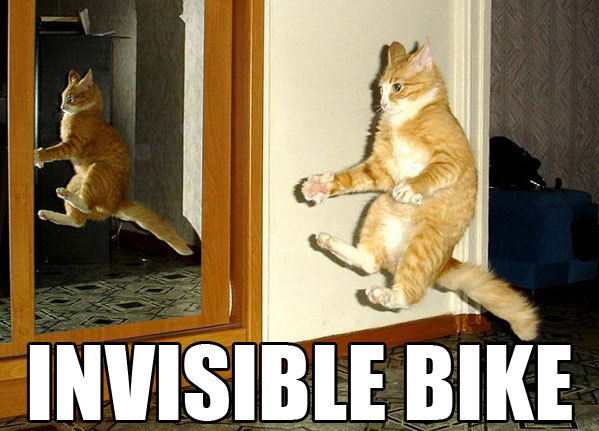
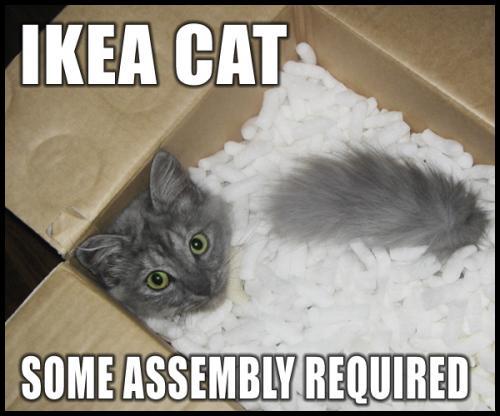
Courtesy of Paul at work, and then Beck (curse you), here are a bunch of funny cat pictures as helpfully stolen and reposted collated by the folks at Meme Cats.

Never shy about stealing and reposting collating myself, I herewith enclose a few of my favorites:

Happy Feet Good. Casino Royale, Eh, Okay

Sunday, November 26th, 2006

Capsule review of my holiday cinema-going:

Happy Feet: Unexpectedly awesome, and proof that you don’t have to be a kid to enjoy a CGI animal movie. Casino Royale: Expectedly just a Bond movie, and confirmation that yes, I really did outgrow that genre sometime in late adolescence.

Dressing Up As Animals

Friday, November 17th, 2006

A fun little link, with photos reposted from Swiss design student Geoffrey Cottenceau’s thesis project, in which he dresses himself up as various animals using common items from the closet. Um, it’s more impressive than it sounds.

More of Cottenceau’s cool projects at gneborg.org.

Thanks to Hiro for the link.

Lies.com Podcast 18

Saturday, May 27th, 2006

I actually recorded this a week ago Friday, but didn’t get around to posting until now. Apologies for the delay. Anyway: Lies.com podcast 18.

In this installment:

  • The recent announcement by the Cornell team of this past winter’s non-findings regarding the Ivory-billed Woodpecker, and my response to some of the discussion that has been taking place at Tom Nelson’s Ivory-bill Skeptic weblog. Note that at one point I refer to him as “Wilson”, and at another point as “Tim Nelson.” Sorry about that. Misidentifications everywhere you look!
  • Seeing Lazuli Buntings and Blue Grosbeaks, woo hoo.
  • Podcasts I’ve been listening to lately: The Hollywood Saloon, Filmspotting (née Cinecast), and Keith and the Girl.
  • The joys of vicarious domestic surveillance via the Internet.
  • The psychology of the long-distance commuter.

Enjoy!

Hitt on the Ivory-billed Woodpecker’s Existence (or Not)

Wednesday, May 10th, 2006

Jack Hitt has an interesting piece in the New York Times Magazine: 13 Ways of Looking at an Ivory-Billed Woodpecker. It does a good job of explaining the way that rare-bird sightings are treated in the world of high-stakes birding.

Soon after the original declaration of the discovery was made last April, controversy broke out, and it quickly got nasty. The ugliness derives from something deep in the heart of birding. Most people think of birding as either a science worthy of a word like “ornithology” or a harmless hobby pursued by rubber-faced old men in porkpie hats. But the act of birding, ultimately, is an act of storytelling. For instance, if someone said to you, “I saw this cardinal fly out of nowhere with yellow tips on its wings and land on the side of a tree,” even the least experienced amateur would counter that cardinals don’t have yellow wingtips and don’t cling to trees but rather perch on branches. Each bird is a tiny protagonist in a tale of natural history, the story of a niche told in a vivid language of color, wing shape, body design, habitat, bill size, movement, flying style and perching habits. The more you know about each individual bird, the better you are at telling this tale.

Claiming to have seen rare birds requires a more delicate form of storytelling and implies a connoisseur’s depth of knowledge. Saying “I saw an ivory-bill’s long black neck and white trailing feathers” requires roughly the same panache as tasting an ancient Bordeaux and discoursing on its notes of nougat and hints of barnyard hay.

If you don’t pull it off, then people presume that you are lying or stupid. And this is where birding gets personal. Telling a rare-bird-sighting story is to ask people to honor your ability as a birder — to trust you, to believe you.

Hitt tells a subtle tale himself about the people who have claimed to see an Ivory-billed recently, offering damning details about their long-held desire to see the bird and their association with the fringe elements of the cryptozoology set. As I’ve described in comments at Tom Nelson’s Ivory-bill Skeptic blog, I don’t think the case against the Ivory-billed’s rediscovery is anywhere near as strong as skeptics have been making out. But this article by Hitt does a good job of explaining why that skepticism exists.

Lies.com Podcast 17

Saturday, May 6th, 2006

More technologically-amplified meat flapping: Lies.com podcast 17. Includes:

  • Audio of the Ray McGovern/Donald Rumsfeld debate.
  • Commentary on same.
  • A little about the Moussaoui verdict.
  • A mind-boggling amount of detail about the new birds I saw at the office this week.
  • Watching a missile launch from Manhattan Beach.
  • Ranting about Bush’s emotional problems.

Enjoy!

Lies.com Podcast 16

Friday, April 28th, 2006

I was feeling pretty low-energy when I started recording this, and I think it shows. For what it’s worth, though, here’s you go: Lies.com Podcast 16.

  • A mention of coming attractions: The as-yet-unposted Lies.com Tenth Anniversary Reader (sitting in my Drafts queue staring at me as I write this, waiting for me to find time to finish it).
  • A digression on why I’m really not interested in debating people who aren’t willing to accept even the possibility that they might be wrong. (I don’t state it that clearly in my comments, but in hindsight I think that’s what I was going for.)
  • An extended revisiting of the Ivory-billed Woodpecker controversy, this time with me providing more specifics about my objections to the approach taken by Sibley et al. in their criticisms of the rediscovery evidence.

That’s it.

More on David Sibley and the Ivory-billed Woodpecker

Thursday, March 23rd, 2006

Some interesting followup links to my earlier story on bird-identification expert David Sibley’s problems with the claims for rediscovery of the Ivory-billed Woodpecker:

Sibley: I Didn’t Include the Ivory-Billed Woodpecker in My Book, So It Doesn’t Exist

Saturday, March 18th, 2006

The New York Times has a brief article on the latest news regarding the rediscovery of the Ivory-Billed Woodpecker: Is Ivory-Billed Woodpecker Alive? A Debate Emerges.

Basically, David Sibley, author of the best field guide to North American birds, has a brief item in the current issue of Science questioning the validity of claims for recent sightings of the bird in Arkansas (Comment on “Ivory-billed Woodpecker (Campephilus principalis) Persists in Continental North America”).

The authors of the original Science article on the rediscovery have a response in the same issue (Response to Comment on “Ivory-billed Woodpecker (Campephilus principalis) Persists in Continental North America”).

Basically, Sibley’s all wet. If you read his (and his co-authors’) criticisms, and the original authors’ response, he really just flat-out loses the argument.

Since Sibley is in some ways the leading expert in the country on bird identification, his criticism is getting a lot of attention. But speaking as someone who’s been involved, at least peripherally, in the world of obsessive birders for more than 30 years, I’ve got my own take on what’s going on here.

Basically, Sibley represents the extreme example of something that turned me off from competitive birding (and yeah, for a certain type of person it actually is a competition) a long time ago. Really obsessive birders tend to be skeptical of claims made by anyone less expert than themselves. Being better at finding and identifying “good” birds (by which they mean, rarities, either birds that are locally rare because they are occurring outside their normal range, or absolute rarities, because there just aren’t very many of them) is how they measure their status, and in that scheme of things, the Ivory-Bill really is the holy grail. For someone like Sibley, the fact that he hasn’t personally seen and identified an Ivory-Billed Woodpecker, while someone else claims to have done so, represents a significant challenge to his sense of self-worth.

This is the same thing that annoys me about certain way-committed skeptics of the paranormal. You can be wrong by being too skeptical, just as you can be wrong by being too credulous. Being skeptical to the point of error isn’t a virtue; you’re still wrong. That’s the trap Sibley has fallen into here.

Stuff on Their Cats

Saturday, January 21st, 2006

I really hope this isn’t some kind of sexual obsession for the people involved. Anyway, courtesy of Jason and Janus/Onan: Stuff on my cat and Wesley Buckaroo.

Lies.com Podcast 10

Saturday, January 21st, 2006

More Bush-bashing (now with perspective!), some discussion of movies (including the Hollywood Saloon podcast, Man on Fire, and the Golden Globes), and extended rambling about The Grail Bird, Tim Gallagher’s book on the recent ivory-billed woodpecker rediscovery: Lies.com Podcast 10.

Top Cryptozoology Stories of 2005

Monday, December 26th, 2005

From the fine people of Crypomundo.com come The top cryptozoology stories of 2005. By all means go there for the details, but here’s the summary:

  1. The Rediscovery of the Ivory-billed Woodpecker
  2. Filming of the First Live Giant Squid
  3. New Homo floresiensis Discoveries
  4. New Animal Discovered in Borneo
  5. First Cryptozoology and Art Symposium at Bates College
  6. Bobby Clarke’s Manitoba Bigfoot Video
  7. Bigfoot Bounty
  8. Mystery Photos of Cryptid Felids and Fish
  9. Disney Yeti Expedition
  10. The Laotian Rock Rat is Discovered at a Meat Market

Komsomolskaya Pravda: Squirrels Kill Dog

Sunday, December 4th, 2005

It was a slow news day in the Siberian town of Lazo. That is, until a pack of ravenous squirrels descended from the trees and then attacked, killed, and ate a stray dog.

More on the Ivory-Billed Woodpecker

Tuesday, August 30th, 2005

From Lies.com Ivory-billed Woodpecker Bureau Chief Ethan P comes this latest New York Times update on the big question at the AOU meeting held last week in my neck of the woods: Ivory Bill or not? The proof flits tantalizingly out of sight.

Fish Story

Saturday, August 27th, 2005

Some fishermen in the Mekong Delta pulled something really big out of their nets back in May: Truly, it was a whopper, but are there bigger fish? The view of the researcher quoted in the story is that no, as of now, he doesn’t have evidence of any bigger (freshwater) fish.

A very big fish

The monster fish was one of just three giant catfish caught in Thailand this year.

Before he headed out on May 1, one of the men who caught it, Thirayuth Panthayom, 29, made sure luck would be on his side. He said he prayed at the shrine of the God of Catfish and begged his boat to help him, “Please, Miss Boat, let me catch something today and I’ll sacrifice a chicken for you.”

He said he had only been out for 15 minutes when he saw the fish smack the water four times with its tail - “Pung! Pung! Pung! Pung!” It took his crew an hour to pull it in.

His father, as owner of the boat, earned nearly $2,000 for the fish from the village fishing association, a fortune in rural Thailand. Mr. Thirayuth, like the other four members of the crew, got $175 of this, which he said he gave right back to his father.

As required by its permit to fish for these endangered catfish, the village association then sold it to the Department of Fisheries, which harvests their eggs and sperm as part of a captive breeding program.

After that, the fish are to be returned to the river, but few have survived the harvesting process, in which hormone injections are administered and the belly is vigorously massaged and manipulated.

The monster fish was returned dead to the fishermen, who cut it into giant steaks and sold it.

When he tried a bit, Mr. Thirayuth said, it tasted soft and sweet and mild.

“It’s hard to describe,” he said. “You have to try it yourself.”

Unforutnately, I seem unlikely to get the chance. Even more unfortunately, the rest of the world’s fish-eaters seem unlikely to have the chance for much longer.

Heinrich: About Animals, About Us

Saturday, August 27th, 2005

I really liked this op-ed piece from Bernd Heinrich, in which he praises the documentary March of the Penguins, while addressing the broader issue of what it means to anthropomorphize animals in movies, and where one might usefully draw the line between things like Bambi and things like Winged Migration: Talk to the animals.

Paradoxically, the cartoonish anthropomorphism of “Bambi,” although it entertained the youngsters, blocked rather than promoted an understanding of animals. In “Bambi” we do not see other creatures. Instead, we are presented humans with antlers, and with our thought and speech. This is what the traditional idea of anthropomorphizing is - expecting animals to feel and behave like humans, which they never will. One look at that penguin with the egg on its toes shows the inadequacy, the outright folly, of wishing they “were more like us.”

Nature is the greatest show on earth, and reverence for life requires acknowledging the differences between ourselves and the animals as well as seeing our relatedness.

Ivory-billed Woodpecker I.D. Questioned, Bolstered

Thursday, August 25th, 2005

Birds are so cool.

First, a quick update on the Ivory-Billed Woodpecker, the long-believed-extinct Liberace of the bird world recently rediscovered (or so we hope) in Arkansas. Tom Nelson has his doubts: my thoughts: Was “Elvis” just a partially leucistic Pileated Woodpecker? But meanwhile, the NYT has an article about how some early skeptics are coming around to the “yup, probably an Ivory-Billed” position based on some interesting sound recordings: Sound files ease doubts on elusive woodpecker.

Meanwhile, if you want a well-written and entertaining insight into what it means to be a birder, check out this piece from Jonathan Franzen in The New Yorker: My bird problem: Love, grief, and a change in the weather.

More Photoshop Phun from Worth1000.com

Tuesday, August 9th, 2005

If you listened to the latest podcast, you know I’ve been obsessing about the credibility of online images lately. Here are a few examples of why, from Worth1000.com:

The last one actually took me a few minutes.

Gelf’s Goldenberg on Mikey the Chimp

Friday, August 5th, 2005

A brief, but thoughtful, article on the use of juvenile chimpanzees in show business, from Gelf Magazine’s David Goldenberg: Meet Mikey, chimpanzee cover boy.

GoDogGo

Friday, July 8th, 2005

To think I was lucky enough to live in these days of miracles and wonders: GoDogGo! The Automatic Fetch Machine! Remote Controlled!

GoDogGo is the first, and still the only, Automatic Fetch Machine for dogs.

Triumph Thinks the Michael Jackson Trial is Great… for Him to Poop On!

Tuesday, June 14th, 2005

So, I guess there was some sort of trial up the road in Santa Maria that ended yesterday? At least, I noticed that at one point in the afternoon the same dumb program, in which a swarm of helicopters follwed a line of black SUVs, was on every channel.

Sigh.

It’s a little late, but Triumph is always good for a laugh. Courtesy of anti-copyright superhero Norm of One Good Move (I think he has a spandex suit in the closet that says “Fair Use Man!” in bold letters across the chest): Triumph The Insult Comic Dog and MJ Fans.

Thinking Without a Brain

Tuesday, June 14th, 2005

I could while away the hours
Conferrin’ with the flowers
Consultin’ with the rain
And my head, I’d be scratchin’
While my thoughts were busy hatchin’
If I only had a brain.

I’ve just finished reading Richard Dawkins’ The Ancestor’s Tale, and it’s had me thinking about the non-neurological component of intelligence.

Dawkins’ book is a journey backwards through our ancestors, cast as a pilgrimage to the “Canterbury” of the remotest common ancestor shared by all life on earth. It’s an interesting journey, in part because of the way it emphasizes the literal truth of the notion that all life is related. Reading the book puts you in the position of imagining what it was actually like to be a pre-human hominid, a shrew-like early mammal, a proto-vertebrate, a worm, an amoeba, a bacterium.

In the ‘later’ (that is to say, earlier) stages of that journey, you’re inhabiting a body that doesn’t have much in the way of a brain. And yet, despite their lack of big cerebral cortexes and the resulting large vocabularies that would let them do things like post rambling conceptual pieces on their weblogs, “simpler” organisms seem to have some pretty interesting abilities that are analogous to what we like to think of as the characteristically “human” manifestation of intelligence.

I also just finished reading Jeremy Narby’s Intelligence in Nature. Narby writes in his book about Martin Giurfa of the Centre of Animal Cognition Research in France, who, along with four co-authors, published The concept of ’sameness’ and ‘difference’ in an insect. In Giurfa’s experiment, bees were trained to enter a simple Y-shaped maze that had been marked at the entrance with a particular color. Inside the maze was a branching point where the bee was required to choose between two paths. One path, which led to the food reward, was marked with the same color that had been used at the entrance to the maze, while the other was marked with a different color. Bees learned to choose the correct path, and continued to do so when a different kind of marker (black and white stripes oriented in various directions) was substituted for the colored markers. When the experimental conditions were reversed, rewarding bees for choosing the inner passage marked with a symbol that was different than the entrance symbol, the bees again learned to choose the correct path. “Thus,” write Giurfa et al., “not only can bees learn specific objects and their physical parameters, but they can also master abstract inter-relationships, such as sameness and difference.”

Narby also talks about slime molds, which in part of their life cycle resemble huge colonial assemblages of one-celled individuals who have fused their cytoplasm into a single enormous (well, by unicellular standards) cell containing thousand of nuclei. Narby visited Japanese scientist Toshiyuki Nakagaki, whose studies have shown that slime molds can “solve” a simple maze, arranging their bodies to lie along the shortest path between two food items placed in opposite corners (see Slime mould solves maze puzzle).

Plants, too, manifest something that could arguably be called intelligence. We hyperactive denizens of kingdom Animalia aren’t really wired to notice it, but on longer time scales plants adapt and respond to their environment, and research has shown that they actually respond surprisingly quickly (albeit in ways not easily visible) to outside stimuli of various kinds — all without benefit of brains, or even individual nerve cells.

Narby visits with Scottish scientist Tony Trewavas, who has been making waves in recent years by publishing studies describing what he refers to as “plant intelligence”. (See Root and branch intelligence and Aspects of plant intelligence.) For example, Trewavas talks about earlier research by CK Kelly showing that dodder, a parasitic plant that takes the form of bright orange twining tendrils (and which I happened to be checking out a couple of days ago while taking a hike in the Caprinteria salt marsh with my son), can quickly discriminate between a “good” host and a poor one, “choosing” in a matter of an hour or two how much of its resources to devote to a particular new host plant.

All of which brings me to the item I actually wanted to talk about when I started this posting: Scientists experiment with ‘trust’ hormone. It’s an article describing recent research into how the hormone oxytocin, which I’m mainly familiar with from its medical use in stimulating contractions during childbirth, can render people more trusting.

Oxytocin is secreted in brain tissue and synthesized by the hypothalamus. This small, but crucial feature located deep in the brain controls biological reactions like hunger, thirst and body temperature, as well as visceral fight-or-flight reactions associated with powerful, basic emotions like fear and anger.

For years oxytocin was considered to be a straightforward reproductive hormone found in both sexes. In both humans and animals, this chemical messenger stimulates uterine contractions in labor and induces milk production. In both women and men, oxytocin is released during sex, too.

Then, elevated concentrations of the hormone also were found in cerebrospinal fluid during and after birth, and experiments showed it was involved in the biochemistry of attachment. It’s a sensible conclusion, given that babies require years of care and the body needs to motivate mothers for the demanding task of childrearing.

In recent years, scientists have wondered whether oxytocin also is generally involved with other aspects of bonding behavior - and specifically whether it stimulates trust.

The article goes on to describe how researchers dosed experimental subjects with oxytocin, then had them play a simple investment game that revealed the level of trust they were willing to extend to a randomly assigned trading partner. Those who got the hormone were dramatically more trusting.

Researchers said they are performing a new round of experiments using brain imaging. “Now that we know that oxytocin has behavioral effects,” Fehr said, “we want to know the brain circuits behind these effects.”

I’m sure there’s more to learn about how the brain is involved in all this, but I wouldn’t be so quick to assume that it necessarily plays the most important role. Brains are a relatively recent innovation. For most of our collective history of living on the planet we haven’t had them — yet we’ve been intelligently negotiating our environment the whole time, presumably through the same sorts of complex chemical interactions that underlie the “intelligent” behavior of our distant relatives, the slime molds and dodder plants.

Okay. Done rambling for now.

Goodall on Chimpanzees, Briefly

Tuesday, June 14th, 2005

I’ve had this kicking around in my post-to-lies folder for a while. It’s a short interview with Jane Goodall: Animals and us: Close encounters

What is the most human-like behaviour you saw in chimpanzees?

Chimps can be deliberately deceptive. For example, when we wanted the young males to get the bananas, the big males would come and take them all, so we took to hiding some of the bananas up in the trees. One day a young male called Figan suddenly looked up into a tree and there was a banana nobody else had seen. He glanced over at three older males grooming. Chimps follow each other’s gaze, and if the males had noticed where Figan had been looking they would have immediately taken the banana, and if he had tried to get it quickly they would have attacked him. I think he knew if he stayed there he wouldn’t be able to resist looking, so he went out of sight. The moment they left, he came back to fetch it.

I very much recommend the whole thing.

The Golden Palace Monkey

Tuesday, May 24th, 2005

Here’s another one of those stories that people more plugged into the world of television than I am probably heard about a long time ago. From an article by David Goldenberg about recent discoveries of hitherto unknown primates (A primate explosion), comes this bit about the Golden Palace monkey:

Robert Wallace, who found the new titi monkey in Bolivia, auctioned off the naming rights for the new species, eventually earning $650,000 for the nonprofit organization that protects the monkey’s habitat (WCS). The Golden Palace casino, the same online company that bought the grilled-cheese sandwich with the image of the Virgin Mary and has paid a woman to name her baby GoldenPalace.com, eventually outbid Ellen DeGeneres for the honor (official site); unsurprisingly, the new species has the scientific name Callicebus aureipalatii, the Golden Palace monkey.

Ivory-billed Woodpecker Found in Arkansas

Thursday, April 28th, 2005

I’ve been watching birds most of my life. I’ve seen a pileated woodpecker just three times; twice when I was 12 years old and living (briefly) in Florida, a third time in my early 20s when visiting my father near Houston. Those sightings were very memorable for me; the pileated woodpecker is a spectacular bird: big as a crow, boldly marked, loud, and boisterous. If a pileated woodpecker were a human, it would be like Muhammed Ali in his prime, only dressed like Liberace. That bird just owns any room it’s in.

Pileated Woodpecker

One of the things that makes the pileated so nifty, at least for me, is the visual reminder it provides of its close relative, the ivory-billed woodpecker. Even larger and more spectacular than the pileated, the ivory-billed has been thought extinct for decades, its population having crashed in the 19th and early 20th centuries after the southeastern old-growth forests it favored were logged.

There were occasional reports, unconfirmed, of someone seeing one in the backwoods somewhere, but experts always ended up concluding that the sightings actually involved misidentified pileateds. For a while the Cuban subspecies of the ivory-billed was believed to have survived, but then it, too, was downgraded to “presumed extinct.” Today’s best bird-watcher’s field guide, the Sibley Guide to the Birds, doesn’t even bother depicting the ivory-billed.

Well, hold on to your hats, bird-lovers: Ivory-billed woodpecker refound in the USA. There’s also coverage from the Washington Post: Woodpecker thought extinct rediscovered, and from Reuters: Ivory billed woodpecker, feared extinct, isn’t.

I realize that the fact that a tiny remnant population (possibly just a single individual) has managed to survive doesn’t offer much hope; the odds are stacked very much against the species’ actually recovering. Species go extinct; it’s the way of things. But like individual death, extinction is forever, and for someone who cherishes the beauty and wonder of creation, staving it off, if only for a little bit, is reason to celebrate.

Yee ha. The ivory-billed woodpecker lives. That makes my day.

Ivory-billed Woodpecker

Update: Here are some additional details courtesy the very-much-abuzz birdwatchers’ mailing lists I subscribe to:

For a while CNN’s web site had a small still image taken from a video of the bird (except it actually wasn’t; see below); that image has been removed now, but Google still had a copy of it:

still from ivory-billed woodpecker video

(Later update: Oh, except that image actually is a still from a test video showing a wooden model of the bird that the researchers used for comparison purposes. See the link below for the actual video image.)

From ivorybill.org (!), a video news release that includes the actual footage of the bird: Video news release.

Finally, in PDF form, the article from Science that came out today: Ivory-billed woodpecker (Campephilus principalis) persists in continental North America.

Stuff Fluffy

Saturday, March 26th, 2005

In good conscience, I can’t not link to this: Pet pillows.

Gods, Mounstrous and Fetching

Monday, February 21st, 2005

Some loosely coupled links for your morning:

An African lion (maybe?) is loose near the Reagan Presidential Library: Lion or tiger, not bear, oh my! And this is an interesting time for me to read that story, because I am just now in the midst of David Quammen’s excellent Monster of God: The Man-Eating Predator in the Jungles of History and the Mind.

In the book, Quammen speculates about what it means to be a large hominid near, but not quite at, the top of the food chain, contemplating the existence of various alpha predators (lions, tigers, leopards, crocodiles, grizzly and polar bears, a few sharks), all of whom share the tendency to occasionally have one of us for lunch.

Quammen is the author of the even-more-excellent The Song of the Dodo: Island Biogeography in an Age of Extinctions, so you can bet Monster of God deals with the consequences of our making it so those alpha predators disappear, and the tension between those who think such predators should be exterminated, and those who think they should be preserved.

But speaking of God and gods reminds me of a site I came across the other day by following the back link from a cherished lies.com commenter. You’ll recall that I previously linked to Jason Salavon, a digital artist who created averaged versions of each of four decades’ Playboy playmates. Now lies.com reader Larry Holdaway has done something similar with the faces of 295 porn stars and nude models, to produce Clotho, Lachesis & Atropos, that is, the three Fates. It’s pretty cool.

While checking that out, I noticed another interesting item from the God- (or gods-) obsessed Holdaway: God and the tool making apes, which links to a 1998 Douglas Adams speech, in which the late author said the following:

…early man has a moment to reflect and he thinks to himself, ‘well, this is an interesting world that I find myself in’ and then he asks himself a very treacherous question, a question which is totally meaningless and fallacious, but only comes about because of the nature of the sort of person he is, the sort of person he has evolved into and the sort of person who has thrived because he thinks this particular way.  Man the maker looks at his world and says ‘So who made this then?’  Who made this? — you can see why it’s a treacherous question.  Early man thinks, ‘Well, because there’s only one sort of being I know about who makes things, whoever made all this must therefore be a much bigger, much more powerful and necessarily invisible, one of me and because I tend to be the strong one who does all the stuff, he’s probably male’.  And so we have the idea of a god.  Then, because when we make things we do it with the intention of doing something with them, early man asks himself , ‘If he made it, what did he make it for?’  Now the real trap springs, because early man is thinking, ‘This world fits me very well.  Here are all these things that support me and feed me and look after me; yes, this world fits me nicely’ and he reaches the inescapable conclusion that whoever made it, made it for him.

Okay. Enough rambling for one morning.

Bonsai Kitten Claims Another Victim

Wednesday, January 19th, 2005

One cool thing about the Internet is that stuff hangs around. Jokes that made the rounds years ago eventually get to be retold to a new audience, with the same amusing results. Like just happened with my daughter, who, when I asked what she was looking at on the computer on the other side of my desk when she should be getting ready for school, started giving me an outraged account of an email she’d just received about Bonsai Kitten.

Me: Uh, Julia, let me tell you about this extremely important web site called snopes.com

Dogs and Their Owners

Wednesday, January 12th, 2005

Inaugurating a mess of brief postings to make up for yesterday’s 4,000-word opus, here’s ganns.com’s Winners of the “I Look Like My Dog” Contest.

Worth1000.com Users’ Bestiary

Sunday, November 21st, 2004

In the tradition of that Human Descent site I’ve linked to previously, here’s a three-beasts-in-one photoshop contest from the users of Worth1000.com: Chimaera 6.

Thanks to Onan for the link.

A Boy and His Cat. And Its Enema.

Sunday, July 11th, 2004

Actually, this isn’t as bad as you think. The illustrations are pretty cool. Tasteful, if somewhat crude (but not crude the way you’re thinking). Anyway: I gave my cat an enema.

Darwinism in Pelicans

Friday, July 9th, 2004

Some people read an article like this and think: “Stupid birds.” Other people think: “There goes mankind, messing up the environment and indirectly killing off a species”.

I read it and thought: “This is fucking hilarious!” …

Pelicans Mistaking Asphalt for Lakes

(Which kind of person are you?)

Excuse Me. Is That a Frog in Your Uterus?

Monday, June 28th, 2004

From the BBC: Iranian woman ‘gives birth to frog’.

An Iranian newspaper has reported the controversial story of a woman who claims to have given birth to a frog.

The Iranian daily Etemaad says the creature is believed to have grown from larva to an adult frog inside her body.

While it is unclear how this could have happened, the paper carries quotes from medical experts who say there are human characteristics to the animal.

It has been speculated that the woman, who has not been named, unknowingly picked up the larva while she was swimming in a dirty pool.

Link courtesy of Patrons of the Absurd.

Infinite Cats

Wednesday, June 2nd, 2004

From Bravo, provider of the best links in the known universe: The infinite cat project.

Neiwart: Let Lolita Go

Wednesday, May 19th, 2004

David Neiwart of Orcinus has a lengthy but very interesting-to-me discussion about the orca Tokitae (or Lolita, if you prefer her stage name): Freeing Lolita.

(Spontaneously) Exploding Whale

Thursday, January 29th, 2004

Everybody knows how gross it can be when a whale blows up. But imagine how bad it would be be if it happened all over your car. Actually, don’t bother imagining — this is why you shouldn’t drive 60-tons of decomposing flesh through the center of town.

Parrot Has 950-Word Vocabulary

Tuesday, January 27th, 2004

One of my favorite books as a young boy was Vinson Brown’s How to Understand Animal Talk. With a little imagination and patience, learning to communicate with another species really isn’t all that hard.

Here’s an example of that sort of communication going in the opposite direction: Parrot’s oratory stuns scientists. The stuff about telepathy, and the generally breathless nature of the story, make me worry that what we’ve really got here is the Brit equivalent of the Weekly World News, but still, it’s fun.

Triumph Does Terry Gross

Thursday, November 20th, 2003

If you’re a fan of Triumph the Insult Comic Dog from Conan, or of Terry Gross, or (especially) both, you definitely owe it to yourself to check out the latter’s interview of the former from today’s show: Fresh Air. It’s great… for me to poop on!

Mobile Dog Messaging

Saturday, October 25th, 2003

Apparently bark translation is the next big thing in Japan. The next logical evolution of this technology is text messaging from your pooch. How exciting, as you sit in you cube and recieve “I have to pee.” messages from man’s best friend.

The Cats Who Walked Though Walls

Monday, September 22nd, 2003

(As seen in the Drudge Report) Aparently, a very sweet old lady with a lot cats died a few years ago, and since then her son has come by every few months with some large bags of cat food and just let the 103 cats have the run of the place … Felines rove in walls as bugs root through filth, building condemned — I really can’t even imagine what kind of person could just walk through feces 3 feet deep to dump some cat food in a kitchen sink.
My favorite quote: “Once the cats breed inside the walls, its economically impossible to clean it up, You can imagine what’s inside those walls, and what the house is going to smell like forever.”
My friend’s favorite quote: “He’s also brought out one dog, a beagle. Jacobson said the dog looked well-fed.”

The Soldier and the Tiger

Sunday, September 21st, 2003

Could there be a more apt allegory? From CNN: US soldier kills Baghdad tiger. There’s also this piece from the AP: US soldier shoots tiger at Baghdad zoo. From the latter:

BAGHDAD, Iraq - A U.S. soldier shot and killed a tiger at the Baghdad zoo after it bit another soldier who had reached through the bars of its cage to feed it, a zoo security guard said Saturday.

The soldiers had been drinking beer when they entered the zoo Thursday night after it closed, said the guard, Zuhair Abdul-Majeed.

“He was drunk,” Abdul-Majeed said of the bitten soldier.

After the man was bit, the other American shot the tiger three times in the head and killed it, Abdul-Majeed told The Associated Press.

Judgement clouded by the effects of alcohol, acting on the basis of a macho impulse without bothering to consider the risk, a soldier decides it would be fun to demonstrate his sense of power and ownership over a predatory beast by feeding it some scraps of meat. The animal is dangerous, to be sure, but it is confined in a cage, and the soldier is armed with the latest high-tech weaponry. It will be fun. And besides, it will demonstrate the soldier’s humanitarian side. He’s helping the animal, see?

Ignoring all warnings, he places himself in close proximity to the tiger, and discovers too late that telescopic sights and laser-guided bombs aren’t a guarantee of safety when you are within arm’s length of razor-sharp claws guided by a hostile will. He falls, wounded, and his companion, in a fit of retribution, kills the still-caged beast with three bullets to the head.

Obviously, the soldier is George Bush (or the USA, more generally); the tiger is Saddam Hussein (or Iraq). Both parties come away from the experience having paid a price, the tiger somewhat moreso. And while the soldier would doubtless blame the tiger for the debacle, a more sober observer might view things differently.

HumanDescent’s Photoshop Bestiary

Wednesday, June 11th, 2003

Here’s one of those things that you come across during random surfing (apologies for having lost track of where I came across the link) that just makes you lean back in your chair and say, “whoa.” Anyway: HumanDescent’s page at b3ta.com. Update: Oh; the real site of the user in question, with even more wackiness, is here: HumanDescent.

Gwynne Dyer 3/3: Chimp Lib

Wednesday, May 28th, 2003

Yet another Gwynne Dyer column I came across this morning, this one on the subject of recent efforts to expand the legal definition of “human” to include closely related species, like chimpanzees: We should grant ‘human rights’ to our closest living relatives.

Monkey Authors Making (Slow) Progress

Friday, May 9th, 2003

From AP, via Janus, comes word of this nifty experiment/performance art: Typing monkeys don’t write Shakespeare. And though it may make no sense to you whatsoever, I really liked Lucy’s comment when Janus mentioned the URL (which included the string ‘britain_monkey_authors’) in the mud: “Even without looking at that article I want it to be about Tommy.” See, it’s funny because Tommy is me in the mud, and I wrote this book with a monkey on the cover and… Oh, never mind. You had to be there.

The AWOL Dolphin Story

Saturday, March 29th, 2003

People keep submitting this story, and I guess it does seem like the sort of thing I would run, even though I chose to pass over it initially. Anyway, by popular demand, here you go: Takoma the dolphin is AWOL. Reader immy2g also helpfully supplied a link to the earlier story: U.S. enlists dolphins to aid war effort.

Carp Warns of Impending Apocalypse

Monday, March 17th, 2003

These are the days of miracles and wonders. What else to conclude after reading the story of the talking carp that began shouting dire predictions - in Hebrew - about the coming end of the world . My favorite part is how the shocked fishsellers who heard the fish went on to butcher and sell it.

PETA Pulls Jewish Chain with Holocaust Comparison

Friday, February 28th, 2003

From Hiro comes word of masskilling.com, where the good folks at PETA compare the plight of animals on factory farms to Jews in WWII-era concentration camps. Needless to say, this has certain folks in an uproar.

Boy Eaten by Python

Wednesday, November 27th, 2002

From a_stupid_box comes this link: Children Terrified As Python Eats Boy. Nasty stuff.